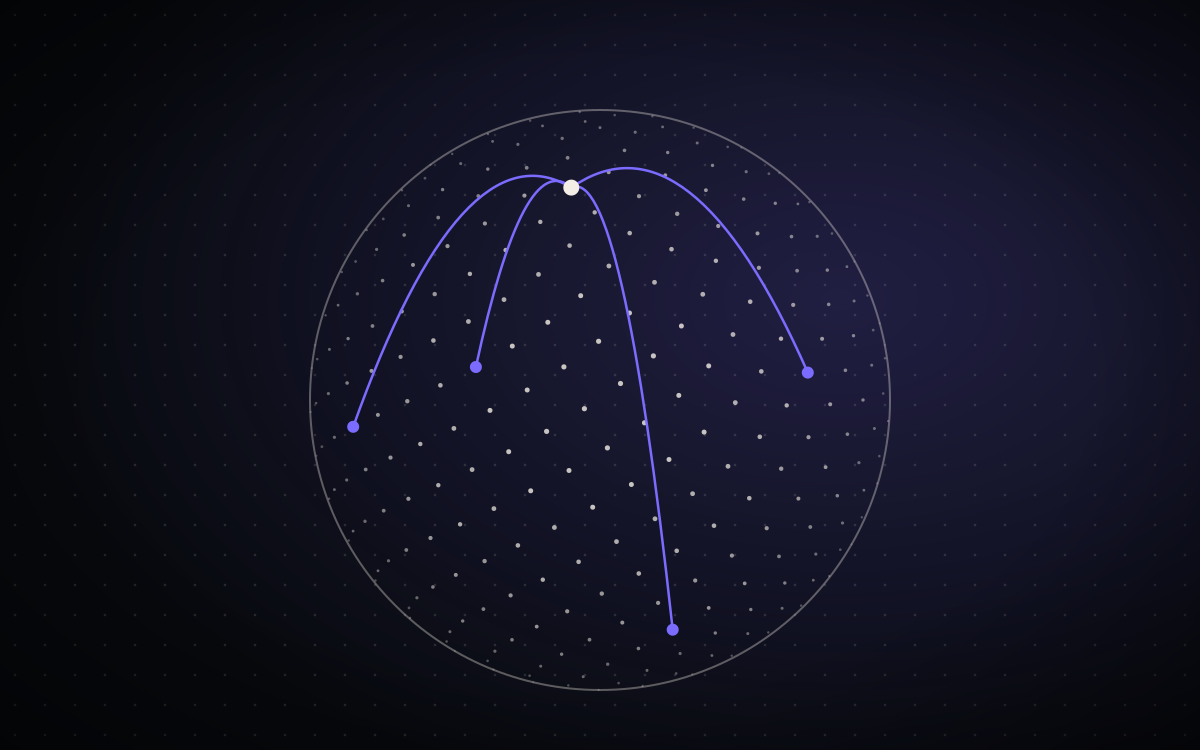
Standard 5 stops to get here · leads to 2
Value Function
A function estimating expected cumulative reward from a state (state-value) or state-action pair (action-value/Q-value).
Your route here
5 stops · basics first
- Machine Learning ✓ understood
Building systems that learn patterns from data instead of following hand-written rules, getting better at a task as they see more examples.
- Reinforcement Learning ✓ understood
Learning through interaction with an environment, receiving rewards or penalties to learn optimal behavior policies.
- Reward ✓ understood
A scalar feedback signal indicating how good an action was, used to train reinforcement learning agents.
- Agent ✓ understood
In RL, the learner or decision-maker that takes actions in an environment to maximize cumulative reward.
- Policy ✓ understood
A strategy or mapping from states to actions that defines the agent's behavior in reinforcement learning.
- Value Function · you are here ✓ understood
Where it sits
Explore nearby
Agents & RL Q-Learning A model-free RL algorithm that learns action-value functions (Q-values) to determine optimal actions in each state. Agents & RL Actor-Critic RL architecture with two components: an actor (policy) that selects actions and a critic (value function) that evaluates them. Agents & RL Markov Decision Process A mathematical framework for modeling sequential decision-making with states, actions, rewards, and transition probabilities. Agents & RL Deep Q-Network Combining Q-learning with deep neural networks to handle high-dimensional state spaces, enabling RL for complex tasks like Atari games.
In the research
All papers →A paper that builds on Value Function .