Landmark 10 stops to get here · leads to 2

Context Window

The maximum number of tokens an LLM can process at once, including both input prompt and generated output. Also called context length.

Your route here

10 stops · basics first
  1. Token ✓ understood

    The basic unit of text that a language model processes, typically representing a word, subword, or character. Tokens are the fundamental building blocks for LLM input and output.

  2. Dataset ✓ understood

    A collection of data examples used for training, validating, or testing machine learning models.

  3. Feature ✓ understood

    A single measurable property of an example, such as a house's floor area or how many links an email contains, used as an input to a model.

  4. Machine Learning ✓ understood

    Building systems that learn patterns from data instead of following hand-written rules, getting better at a task as they see more examples.

  5. Neural Network ✓ understood

    A computational model inspired by biological neural networks, consisting of interconnected nodes (neurons) organized in layers that process information through weighted connections.

  6. Deep Learning ✓ understood

    A subset of machine learning that uses neural networks with multiple layers (deep neural networks) to learn hierarchical representations of data.

  7. Representation Learning ✓ understood

    Learning useful features or representations of data automatically, rather than hand-crafting them.

  8. Embedding ✓ understood

    A list of numbers (a vector) that represents a word, sentence, image or other item, learned so that similar items end up close together.

  9. Attention Mechanism ✓ understood

    A technique that lets a neural network weigh every part of its input when producing each output, focusing on the parts most relevant at that step.

  10. Transformer ✓ understood

    A neural network architecture, introduced in 2017, built from stacked self-attention and feed-forward layers; the basis of nearly every modern large language model.

  11. Context Window · you are here ✓ understood
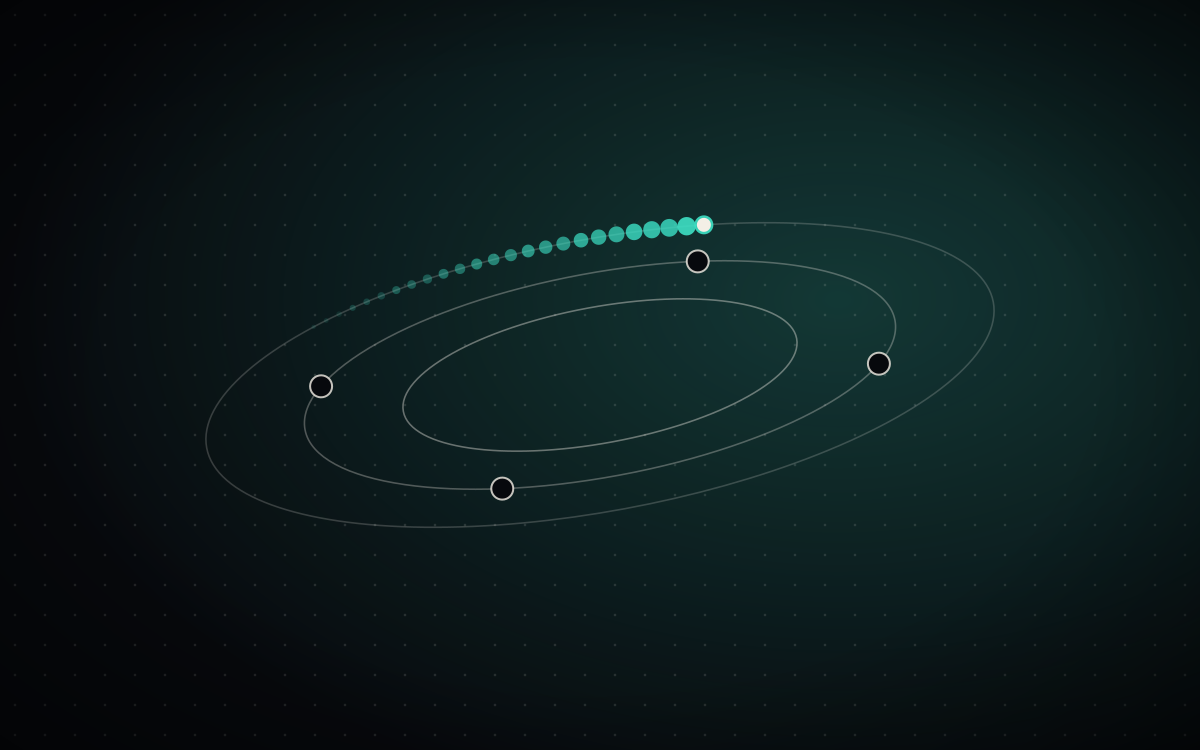
Picture it

CONTEXT WINDOW · ILLUSTRATIVEsystem promptconversationdocumentsoutputlimitoverflow
Notice how system prompt, conversation, documents and output all share one fixed budget, and anything past it overflows.

The context window is a critical limitation of language models. It determines how much information the model can “remember” and work with simultaneously.

Evolution

  • Early models: 512-2048 tokens
  • GPT-3: 2048-4096 tokens
  • Modern models: 8K-200K+ tokens (Claude, GPT-4, Gemini)
  • Research models: 1M+ tokens

Technical Constraint

Context windows are limited because attention mechanisms have O(n²) complexity with sequence length, making longer contexts computationally expensive and memory-intensive.

Practical Impact

Larger context windows enable:

  • Processing entire codebases or books
  • Maintaining longer conversations
  • Working with more examples in prompts
  • Better understanding of complex, interconnected information

Where it sits

Context Window

Explore nearby

In the research

All papers →

12 papers that build on Context Window ; showing 5, canon first.

Frontier · Nov 2025 · 1.8K citations Qwen3-VL Technical Report It is the most-cited paper of the year and a reference point for open multimodal models. Frontier · Oct 2025 · 236 citations Agentic Context Engineering: Evolving Contexts for Self-Improving Language Models It gives a principled shape to “context engineering”, the craft behind most agent harnesses. Frontier · Dec 2025 · 232 citations Memory in the Age of AI Agents A shared vocabulary for agent memory, one of the least settled parts of agent design. Frontier · Oct 2025 · 159 citations DeepSeek-OCR: Contexts Optical Compression It raises a new idea for long context: compress old history visually instead of keeping every text token. Frontier · Oct 2025 · 116 citations Kimi Linear: An Expressive, Efficient Attention Architecture It is a credible claim that linear attention can replace full attention without a quality penalty.